
Challenge 1: Convert hex to base64
Problem
Convert hex to base64
The string:49276d206b696c6c696e6720796f757220627261696e206c696b65206120706f69736f6e6f7573206d757368726f6f6d
Should produce:SSdtIGtpbGxpbmcgeW91ciBicmFpbiBsaWtlIGEgcG9pc29ub3VzIG11c2hyb29t
Solution
Strategy
- Convert hex to Decoded String
- Convert String to Base64
Explanation
First decoding our input hex encoded string to binary. To hex encode a string we break each byte of string into two 4 bits and then convert each 4 bits to hex. For example, Hello is encoded as 48656c6c6f in hex. The first byte 72 translate to 01001000 in binary splitting 4 bits at a time we get 0100 1000 which is 48 in hex.
hello := "Hello"fmt.Println([]byte(hello)) //[72 101 108 108 111]We have 49276d206b696c6c696e6720796f757220627261696e206c696b65206120706f69736f6e6f7573206d757368726f6f6d, first two characters 49 translates to 01001001 in binary, 73 in decimal and I in ASCII.
Now that we have decoded from hex encoding, we need to encode it to base64.
- We break it down into bytes and take 3 bytes of binary data and split it into 4 groups of 6 bits each.
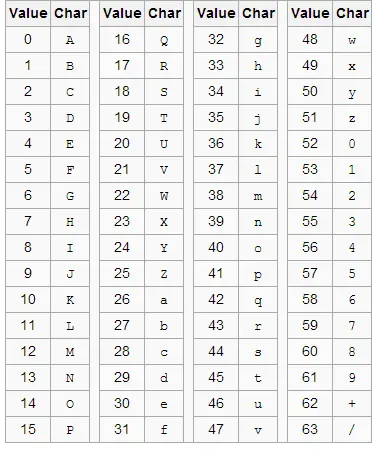
- Each group of 6 bits is then converted to a character in the base64 alphabet.
- If the last bits come short of bits we pad it with
=.
For example, I'm is represented by the bytes 73 39 109, which in binary is 01001001 00100111 01101101. Splitting this into groups of 6 bits gives 010010 010010 011101 101101 which translates to S S d t in base64.
Success

Code
package challenge1
import (  "encoding/base64"  "encoding/hex"  "fmt")
func Challenge1() {  // HEX Decode  hexEncoded := []byte("49276d206b696c6c696e6720796f757220627261696e206c696b65206120706f69736f6e6f7573206d757368726f6f6d")
  hexDecoded := DecodeHex(hexEncoded)  fmt.Printf("Hex Decoded: %s", hexDecoded)
  // Base64 Encode  encoded := EncodeBase64(hexDecoded)  fmt.Printf("\nBase64: %s", encoded)}
func DecodeHex(input []byte) []byte {  decoded := make([]byte, hex.DecodedLen(len(input)))
  _, err := hex.Decode(decoded, input)  if err != nil {    fmt.Printf("\nError:%s\n", err)    return nil  }  return decoded}
func EncodeHex(in []byte) []byte {  encoded := make([]byte, hex.EncodedLen(len(in)))  hex.Encode(encoded, in)  return encoded}
func EncodeBase64(input []byte) []byte {  encoded := make([]byte, base64.StdEncoding.EncodedLen(len(input)))  base64.StdEncoding.Encode(encoded, input)  return encoded}
func DecodeBase64(input []byte) []byte {  decoded := make([]byte, base64.RawStdEncoding.DecodedLen(len(input)))  _, err := base64.RawStdEncoding.Decode(decoded, input)  if err != nil {    fmt.Printf("\nError:%s\n", err)    return nil  }  return decoded}